The Social Trading Boom: Can You Really Profit by Copying Others?
Copy my trades and get rich." It’s the oldest marketing hook on the internet, now supercharged by 2026’s algorithmic social trading platforms. But behind the flashy leaderboards lies a hidden world of latency slippage, mismatched risk profiles, and aggressive survivorship bias. Discover the institutional truth about copy trading and why outsourcing your execution rarely outsources your risk.
Investing used to be a solitary endeavor. You did your own research, stared at your own charts, and made your own decisions in a silo. But in the era of social media, the financial markets have undergone a radical transformation. Welcome to the age of Social Trading.
Driven by platforms like eToro, ZuluTrade, and specialized crypto exchanges, the hottest trend in retail investing right now is "Copy Trading." Instead of trying to beat the market on their own, new investors are simply linking their accounts to seasoned veterans and letting automation do the rest.
Here is a deep dive into how copy trading is reshaping the markets, and whether it is a legitimate strategy or just another financial fad.
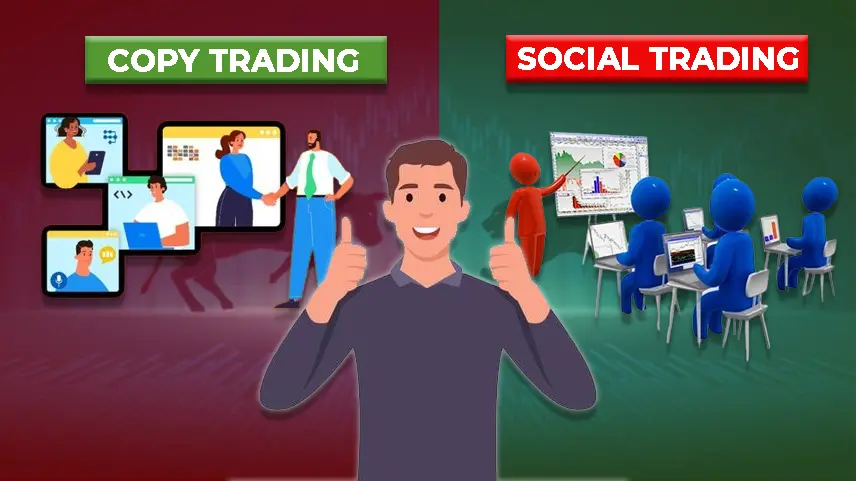
What Exactly is Copy Trading?
At its core, copy trading is exactly what it sounds like. You browse a leaderboard of "Lead Traders" on a social investing platform, reviewing their historical returns, risk metrics, and preferred asset classes.
Once you find a trader whose strategy you like, you allocate a portion of your capital to "copy" them. From that moment on, whenever the Lead Trader executes a trade in their own account, your account automatically executes the exact same trade in real-time, scaled proportionally to your capital. If they buy 10 shares of Tesla, you buy a proportional amount. If they sell, you sell.
Why the Massive Surge in Popularity?
1. The Ultimate "Set It and Forget It" The biggest barrier to entry for day trading or swing trading is the time commitment. Learning technical analysis, reading SEC filings, and monitoring live price action is a full-time job. Copy trading appeals to the masses because it offers the potential for active trading returns with the passive effort of a standard index fund.
2. Learning While Earning For beginners, the stock market is incredibly intimidating. Copy trading allows novices to look over the shoulder of profitable traders. By watching the exact entry and exit points of a seasoned veteran in real-time, new investors can reverse-engineer successful strategies and learn market mechanics with skin in the game.
3. The Democratization of Hedge Funds In traditional finance, if you wanted a professional to actively manage your money, you had to invest in a hedge fund—which usually requires a minimum net worth of over $1 million. Copy trading acts as a decentralized hedge fund for the everyday person, allowing someone with just $500 to have their portfolio actively managed by a top-performing trader.
The Hidden Risks of Copying
While the marketing is enticing, copy trading is not a guaranteed path to wealth. It carries significant, often misunderstood risks:
Past Performance Does Not Guarantee Future Results: A trader who made 200% last year during a massive bull run might completely blow up their account during a bear market.
The "Skin in the Game" Illusion: Some Lead Traders take massive, reckless risks because they earn commission fees from their copiers. If their high-risk strategy fails, they still collect their fees, while the copiers lose their actual capital.
Execution Slippage: In highly volatile markets, the Lead Trader might get filled at a great price, but by the time the automated system executes the trade for thousands of copiers a fraction of a second later, the price may have worsened significantly.
A Permanent Shift in Retail Investing
Whether you love it or hate it, social trading is here to stay. It has fundamentally lowered the barrier to entry for active investing, turning the stock market into a multiplayer ecosystem.
Before you click "Copy" on a trader with flashy returns, remember to look under the hood. Check their maximum drawdown, their average holding time, and their risk score. In the world of social finance, trusting the right person is just as important as picking the right stock.
The Allure of the Leaderboard
The pitch of Social Trading is undeniable: browse a leaderboard, find a "Master Trader" with a 300% annual return, click "Copy," and let their expertise grow your account while you sleep. Platforms have gamified this process to make it look as easy as following an influencer on social media.
However, institutional investors don't "copy trade"; they allocate capital to vetted hedge funds. The difference between those two concepts is where retail traders lose all their money.
The Hidden Destroyers of Copied Alpha
If the Master Trader makes 10% this month, you assume you make 10%. Mathematically, that is almost impossible in the retail copy-trading ecosystem. Here is what the marketing brochures don't tell you:
1. The Latency Trap (Slippage) When a Master Trader executes a high-momentum breakout trade, they get the exact price they clicked. But their platform then has to broadcast that signal to thousands of copiers. By the time your account automatically executes the trade—even if it's just milliseconds later—high-frequency algorithms have already moved the price.
The Result: You enter higher and exit lower than the Master. This "slippage" can turn a winning strategy into a losing one instantly.
2. The Account Size Mismatch Risk management does not scale perfectly in reverse. A Master Trader might be trading a ₹5 Crore account. If they take a trade and it draws down by ₹5 Lakhs, that is a minor 1% float; they hold the position, and it eventually becomes profitable.
The Result: If you are copying them with a ₹50,000 account, proportional scaling often breaks down due to minimum lot sizes and margin requirements. Your broker will trigger an auto-square-off (margin call) right before the trade becomes profitable. The Master wins; you lose.
3. Survivorship Bias Social trading leaderboards only show the survivors. If 1,000 traders flip a coin on every trade, purely by statistical luck, one of them will flip "heads" ten times in a row and show a 1,000% return.
The Result: Retail traders flock to copy the "lucky" trader right as their luck runs out and mean reversion hits. The platform quietly deletes the blown-up accounts, keeping the leaderboard looking pristine.
How to Actually Use Social Trading
If you must use a copy-trading platform, treat yourself as a "Fund of Funds" manager, not a passive gambler.
Audit the Drawdown: Ignore the "Total Profit" metric. Look exclusively at the "Maximum Drawdown." If a trader made 200% but had an 80% drawdown to get there, they are a ticking time bomb.
Diversify the Signal: Do not put 100% of your capital behind one Master. Allocate 10% blocks to 5 different traders who use uncorrelated strategies (e.g., one algorithmic options seller, one commodities swing trader, one equity investor).
Account for Fixed Costs: If you have a ₹20,000 account and pay ₹1,500 a month in subscription fees, your Master Trader has to generate an 8% return every single month just for you to break even.
Conclusion: You Cannot Outsource Conviction
The biggest flaw in copy trading is psychological. When a strategy hits an inevitable losing streak, a real trader holds on because they have mathematical conviction in their backtesting. A copy trader simply panics, hits "Disconnect," and locks in the loss at the exact bottom. You can outsource the execution, but you can never outsource the discipline.
💡 The "Skin in the Game" Test
Never copy a "trader" who earns more from subscription fees than their actual PnL. If they risk tiny capital while collecting massive follower fees, they are marketers, not traders. You take the risk; they take the guaranteed cash.
The only way to achieve +3R or +5R trades is to stop taking your profits too early. When a trade hits +1R, move your stop-loss to break-even. Let the market take you out. You must give your winners the room to become "outliers.