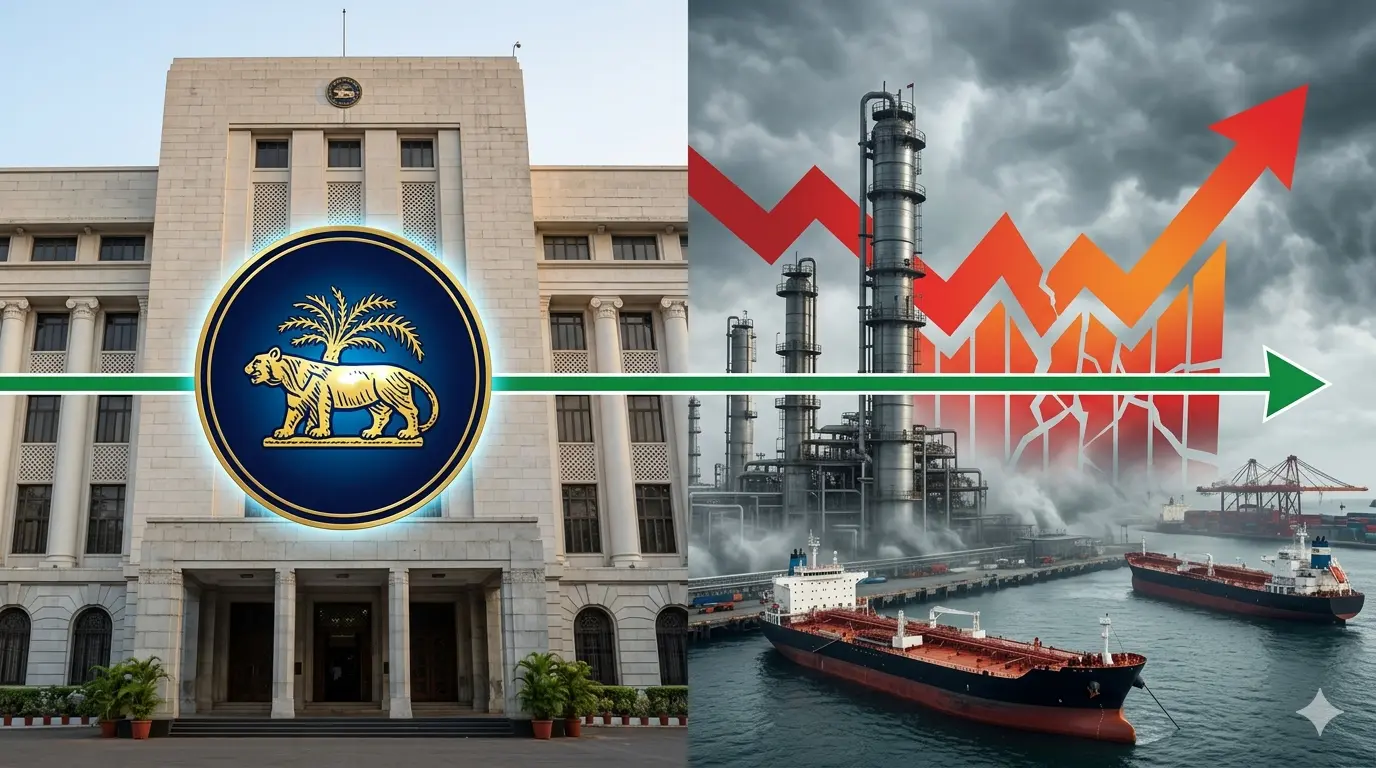
RBI Policy April 2026: Rate Hold Expected Amid Oil Shock and Market Volatility
Following a massive stock market crash triggered by escalating Middle East tensions and crude oil prices crossing $106 per barrel, all eyes are on the upcoming RBI Monetary Policy Committee (MPC) meeting. Discover why experts widely expect the central bank to maintain the repo rate at 5.25%.
The RBI MPC Meeting: Navigating the April 2026 Crisis
This makes the forthcoming Reserve Bank of India (RBI) Monetary Policy Committee (MPC) meeting on April 6–8, 2026, particularly significant and sensitive for the Indian economy. Dalal Street saw a severe crash just days ago, with the Sensex and Nifty 50 tumbling over 2% in one trading session (Bing, 2026). Shifting the macroeconomic narrative from “growth” back to “crisis management” is a mix of rising geopolitical tensions in the Middle East, relentless Foreign Institutional Investor (FII) selling, and a sudden increase in Brent crude oil price.
Why a "Rate Hold" is the Most Likely Outcome
Between February and December 2025, the RBI dived the repo rate by 125 basis points (reducing it from 6.50% to 5.25%) to drive growth. However, there is a unanimous expert opinion that the aggressive easing cycle is over for now. This is the reason why the central bank is expected to keep the rates unchanged:
1. The Crude Oil Shock: Brent crude oil recently crossed the $106 to $124 a barrel mark due to fears of the Strait of Hormuz being closed. Since India imports nearly 85 per cent of its crude oil requirements, this huge price rise threatens to further widen the trade deficit and instantaneously, imports inflation into the domestic economy.
2. Inflation Fears Renewed: The easy inflation path from late 2025 has been completely disrupted. This oil price shock, plus increased freight charges and the depreciation of the rupee (which recently lost 94 points against the US Dollar), has compelled analysts to produce revised retail inflation estimates for FY27. Inflation is now predicted to climb perilously close to the Reserve Bank of India’s (RBI) six per cent upper tolerance limit.
3. Protecting Rupee: 3 Protecting the RupeeA widening yield gap between the US and India, coupled with the massive foreign capital outflows (over ₹1 14 lakh crore in March 2026 alone) has put immense pressure on the INR. Therefore, cutting domestic interest rates at this juncture will further worsen the depreciation of the currency.
The well-bought inflation outlook from late 2025 is completely overturned. The benign inflation outlook from late 2025 has been completely overturned; the MPC must now address this imported inflation risk directly even as domestic demand shows signs of moderation.
A Quick Look at RBI's Recent Rate Cycle
To understand the present situation, it is important to look at how the RBI has managed rates in the past year:
Policy month Action on the Repo Rate Present Repo Rate Policy stance Jun 2025 By 50 basis points 5.50% Neutral August 2025 Hold 5.50% Neutral. October 2025 Hold 5.50% Neutral December 2025 Cut by 25 basis points 5.25% Neutral February-2026 Hold 5.25% Neutral April 2026 (Expected) Hold 5.25% Neutral;
Policy Month | Repo Rate Action | Current Repo Rate | Policy Stance |
June 2025 | Cut by 50 bps | 5.50% | Neutral |
August 2025 | Hold | 5.50% | Neutral |
October 2025 | Hold | 5.50% | Neutral |
December 2025 | Cut by 25 bps | 5.25% | Neutral |
February 2026 | Hold | 5.25% | Neutral |
April 2026 (Expected) | Hold | 5.25% | Neutral |
What This Means for Retail Borrowers & Investors
If the RBI holds the repo rate at 5.25 per cent, as predicted, there will more be a feeling of stability than relief, in the immediate impact it has upon retail consumers:
Home & Auto Loans: EMIs for the floating-rate loan borrowers linked to external benchmark-linked (EBLR) are unlikely to dip further in the foreseeable future. But the same can be said about the risk of aggressive rate hikes over a short period, which at least for now is limited.
Fixed Deposits: Banks will likely keep fixed deposit (FD) interest rates constant to attract domestic liquidity in the absence of foreign inflows.
Stock Market Outlook: neutral bias and rate hold is factored in already. However, hawkish commentary on the future risk of inflation from the RBI Governor Sanjay Malhotra could lead to further sell-offs in rate-sensitive sectors such as Banking and the Auto industry.
Investors need to prepare for more volatility and MPC’s commentary on GDP growth forecasts and inflation projections on April 8.
What the RBI Policy Means for Your Money
If the RBI holds rates steady, retail borrowers are unlikely to see further immediate relief on home and auto loan EMIs. Conversely, fixed deposit rates should remain stable as banks look to attract domestic liquidity.
The Reserve Bank of India faces mounting pressure as surging global crude oil prices threaten to drive up domestic inflation ahead of the crucial April 2026 MPC meeting.