
Market Crash: Why Sensex and Nifty Ended FY26 on a Sharp Decline
The Indian stock market ended the financial year 2025 – 26 on a bearish note. The Sensex and Nifty plunged due to escalating geopolitical tensions in the Middle East, surging crude oil prices and heavy FPI selling. Know the key triggers behind the March 2026 sell-off.
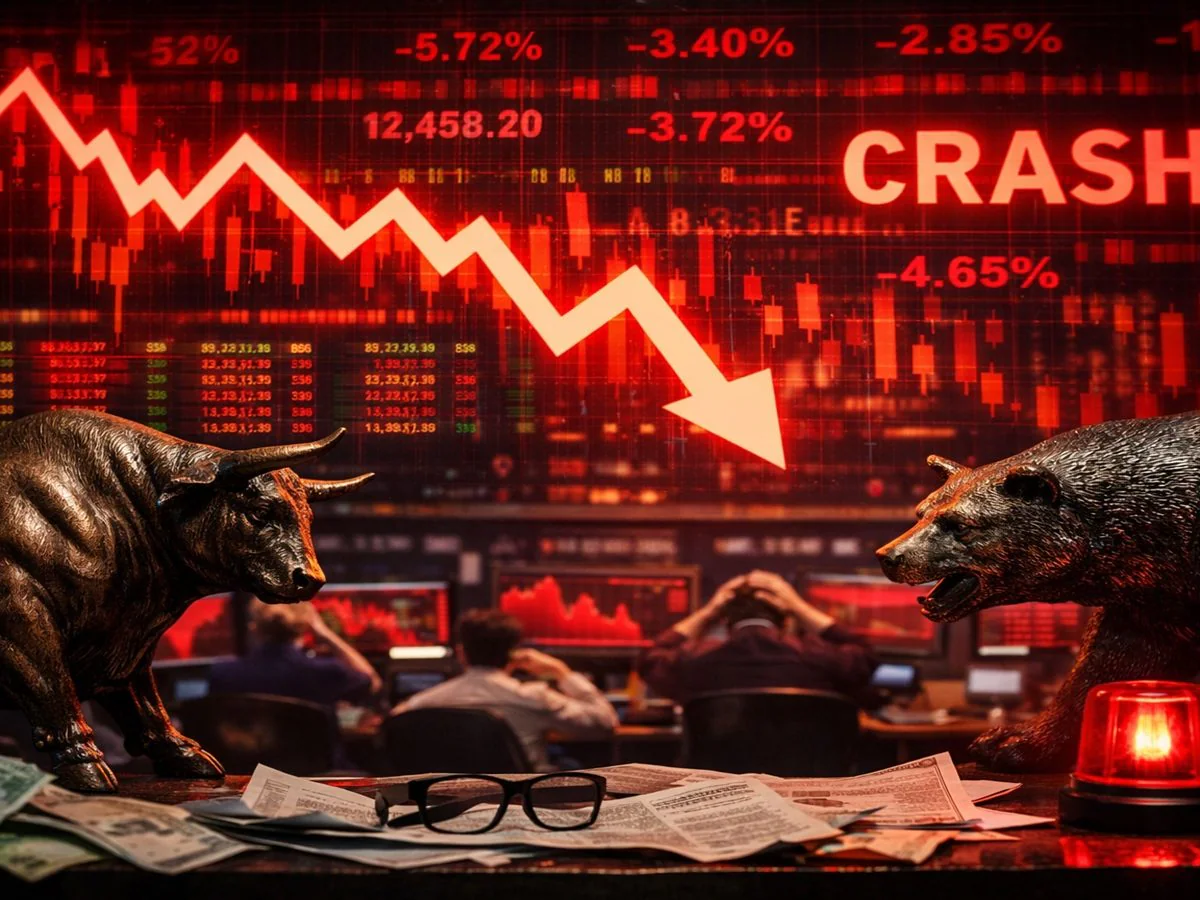
The final trading sessions at the end of the financial year 2025-26 were tumultuous for Dalal Street. The BSE Sensex plummeted by over 1,600 points or gained 2.22% to end at 71947, and the Nifty 50 dropped by 488 points to close at 22331 on Monday, March 30, 2026. (Note: The stock markets remain officially closed today Tuesday, March 31, 2026, due to Mahavir Jayanti).
It capped off a difficult month on the Indian equities markets where the benchmark indices fell by nearly 10% overall in March, a scenario that saw one of the sharpest monthly market corrections in recent years.
5 Key Triggers Behind the Market Fall
The market correction witnessed recently is largely driven by a combination of global headwinds and domestic pressures. Below is a breakdown of the main factors driving the indices down.
1. Geopolitical Tensions in the Middle East: The growing conflict between the US, Israel, and Iran has had a significant impact on risk appetite globally. Worries that the important global oil transport route, the Strait of Hormuz might be shutdown have induced panic in global equity markets.
2. Crude Oil Prices: Brent crude oil price has aggressively crossed 115 dollars per barrel. As India is a massive net importer of oil, this surge threatens to widen the trade deficit and stoke inflation, squeezing corporate margins across oil-sensitive segments like transportation and manufacturing.
3. Indian Rupees Touching New Lows: There has been massive pressure on the INR which is touching new lows at about 94.7 against the dollar. This makes imports enormously expensive and raises fears of inflation, thereby caving in pressures on the RBI.
4. Relentless FII/FPI Selling: Foreign Institutional Investors (FIIs) and Foreign Portfolio Investors have pulled out heavy capital from the Indian market in March. As the global uncertainty increased, foreign investors preferred investing in gold and bonds in the US.
5. Heightened Market Volatility: The India VIX (volatility index) surged to over 26 recently, indicating that market participants are factoring in heightened uncertainty. This leads to sharp intraday swings and a defensive positioning.
Sectoral Impact: Banking Takes a Hit
The sell-off was universal, though the banking and financial services sector bore the brunt of the crash with the Nifty Bank index plummeting by almost 16% over the month. The last session’s major losers were the top heavyweights;
State Bank of India (SBI)
Bajaj Finance
Kotak Mahindra Bank
Reliance Industries.
On the other hand, IT and Pharma sectors saw relatively stronger results, with companies like Tech Mahindra and TCS closing with slight gains or experiencing less severe losses. “Short-term news generates noise, while investors need to focus on long-term growth and think in terms of a 7-year horizon. It is better to see which way there is a decisive breakout and thereafter take fresh directional bets.”
Index | Close Value | Point Change | Percentage Change |
BSE Sensex | 71,947.20 | -1,602.15 | -2.22% |
Nifty 50 | 22,331.05 | -488.40 | -2.14% |
Nifty Bank | 45,120.50 | -1,150.30 | -2.48% |
Nifty Midcap 100 | 46,210.80 | -1,420.60 | -2.98% |
Nifty Smallcap 100 | 14,890.25 | -510.15 | -3.31% |
How Retail Investors Should Navigate the Turbulence
Market crashes can be intimidating, especially for retail investors who entered during the bull run of late 2024 and 2025. Financial advisors recommend the following survival strategies:
Avoid Panic Selling: Selling quality stocks in a falling market often locks in losses. Review your portfolio fundamentally rather than emotionally.
Stick to Asset Allocation: Rebalance your portfolio to ensure your ratio of equity, debt, and gold aligns with your original risk appetite. Gold typically acts as a hedge during geopolitical crises.
Continue SIPs: Do not stop your Systematic Investment Plans (SIPs). Buying units at a lower Net Asset Value (NAV) averages out your cost over time.
Keep Cash Ready for Dips: For those with liquidity, corrections present a great opportunity to accumulate blue-chip stocks at discounted valuations.
What to Expect in April 2026?
April has always brought in fresh momentum with the fresh financial year inflows and optimism. However, with global tensions refusing to cool down, oil prices boiling and continuous foreign outflows, the much-talked-about April effect may be drowned in all these factors this time around.
Traders are highly recommended to;
Keep stringent stop losses. Do not over-leverage in the Futures & Options (F&O) segment. Focusing on fundamentally strong quality stocks with defensive characteristics.
Investor Advice: What to Do During the Market Correction
Worried about the FY26 market crash? Financial experts advise retail investors to avoid panic selling, maintain long-term SIPs, and use this Sensex and Nifty dip as an opportunity to buy fundamentally strong stocks.
Investors watch in dismay as the Nifty 50 and Sensex register steep losses, wiping out significant wealth at the close of FY26.
