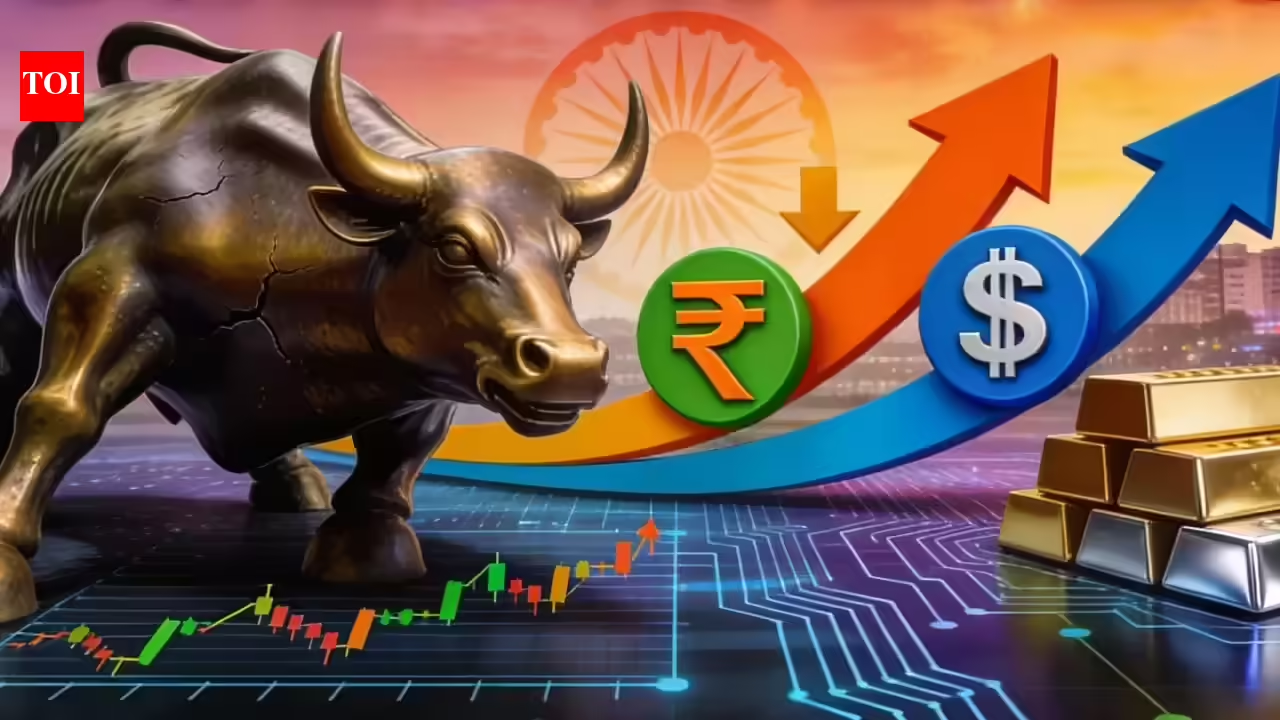
India-US Trade Deal Sparks Historic Market Rally: Sensex Surges 2,000 Points
Indian equity benchmarks surged to new heights in early April 2026 following a landmark India-US trade deal and easing geopolitical tensions in the Middle East. Discover the top reasons behind this massive market rally and the sectors benefiting the most.

Sensex and Nifty Rally on Landmark Trade Agreement
After a period of intense volatility and market corrections driven by global geopolitical tensions, Indian equity benchmarks witnessed a spectacular turnaround in the first week of April 2026. The BSE Sensex closed higher by a staggering 2,072 points, while the Nifty 50 surged aggressively, completely erasing the massive losses recorded at the end of March.
The primary catalyst for this historic bull run is the finalization of a monumental trade deal between India and the United States, alongside positive global cues regarding the Middle East conflict.
Indian equity markets witnessed an extraordinary turnaround today, marking a monumental shift in market sentiment. In a stunning display of optimism, the BSE Sensex skyrocketed over 2,000 points to settle around the 83,739 mark, while the NSE Nifty 50 surged past 25,700, driven primarily by the announcement of a landmark trade agreement between India and the United States.
This "game-changer" deal has not only removed months of tariff uncertainty but has also triggered a massive rally in export-oriented sectors, leading to a single-session increase in investor wealth of over ₹12 lakh crore.
4 Reasons Why the Indian Share Market is Rising
The sudden shift from a bearish correction to a massive bull run can be attributed to four major macroeconomic developments:
The India-US Trade Deal: The US and India have successfully reached a landmark trade agreement, slashing tariffs on Indian exports from 50% to 18%. This highly anticipated move is expected to significantly boost India's export economy and lift corporate earnings across multiple sectors.
Competitive Export Advantage: With the new 18% tariff rate, India gains a massive competitive edge over regional manufacturing hubs. Competitors like Bangladesh, Vietnam, and Taiwan currently face 20% tariffs, while Indonesia and Thailand face 19%.
Easing Geopolitical Tensions: Global market sentiment improved drastically after US leadership signaled that an end to the Iran conflict could be near, cooling off the recent crude oil shock that had pushed prices past the $115 per barrel mark.
The Rupee Bounces Back: Following the trade deal announcement and active RBI intervention, the Indian Rupee strengthened significantly, gaining more than 1% to reach 90.30 against the US Dollar.
The Catalyst: Landmark India-US Trade Deal
For months, Indian markets were weighed down by fears of high U.S. tariffs, particularly regarding Indo-Russian oil trade trade links. The new trade agreement, confirmed on February 3, 2026, has brought immediate relief.
Tariff Cut:The U.S. has agreed to reduce reciprocal tariffs on Indian goods from nearly 50% to 18%.
Removal of Punitive Duties:The 25% punitive levy linked to the Indo-Russian oil trade was fully withdrawn, improving competitiveness for Indian exports.
Sectoral Impact:Export-heavy sectors such as textiles, leather, aquaculture, chemicals, and IT are expected to see renewed earnings visibility.
Sectoral Impact: IT and Auto Lead the Charge
The trade deal heavily favored export-oriented sectors, with Information Technology (IT) stocks witnessing aggressive buying. Companies like HCL Technologies, Tech Mahindra, and Infosys emerged as the top gainers, soaring on the prospect of increased US client spending and favorable export conditions.
Additionally, the auto sector saw strong momentum. Industry giants reported robust March 2026 sales figures, with domestic passenger vehicle sales jumping significantly year-on-year.
Top Nifty 50 Gainers (Early April 2026)
Company Name | Sector | Percentage Gain |
HCL Technologies | IT Services | +3.53% |
Tech Mahindra | IT Services | +2.63% |
Infosys | IT Services | +1.97% |
Wipro | IT Services | +1.95% |
Tata Consumer | FMCG | +1.78% |
"The reduction of US tariffs to 18% is a watershed moment for Indian manufacturing and IT services. Combined with cooling oil prices, this creates a perfect macroeconomic tailwind for a sustained bull market in FY27."
What Investors Should Do Next
While the market euphoria is justified, retail investors are advised to remain focused on quality fundamentals. The recent volatility serves as a reminder that geopolitical risks can escalate quickly. Investors should utilize this rally to rebalance their portfolios, maintain their Systematic Investment Plans (SIPs), and target companies with strong export footprints that will directly benefit from the new US trade policies.
Why is the Indian Stock Market Going Up Today?
A landmark trade agreement between India and the US, slashing export tariffs to 18%, combined with easing geopolitical tensions and cooling crude oil prices, triggered a historic 2,000-point surge in the Sensex.
As the Indian markets charge to new heights, investors are closely watching the dynamic interplay between the Rupee, the Dollar, and domestic market indices.