The Trading Psychology Angle: "Why Your Brain is Hardwired to Buy High and Sell Low"
Have you ever noticed that the moment you buy a stock, it immediately crashes? And the moment you finally give up and sell it, it skyrockets? The market isn't watching you. Your brain is just fundamentally hardwired to lose money. Discover the evolutionary psychology behind FOMO, Prospect Theory, and the exact mental frameworks institutional traders use to completely divorce their ego from their capital.
The Evolutionary Disadvantage
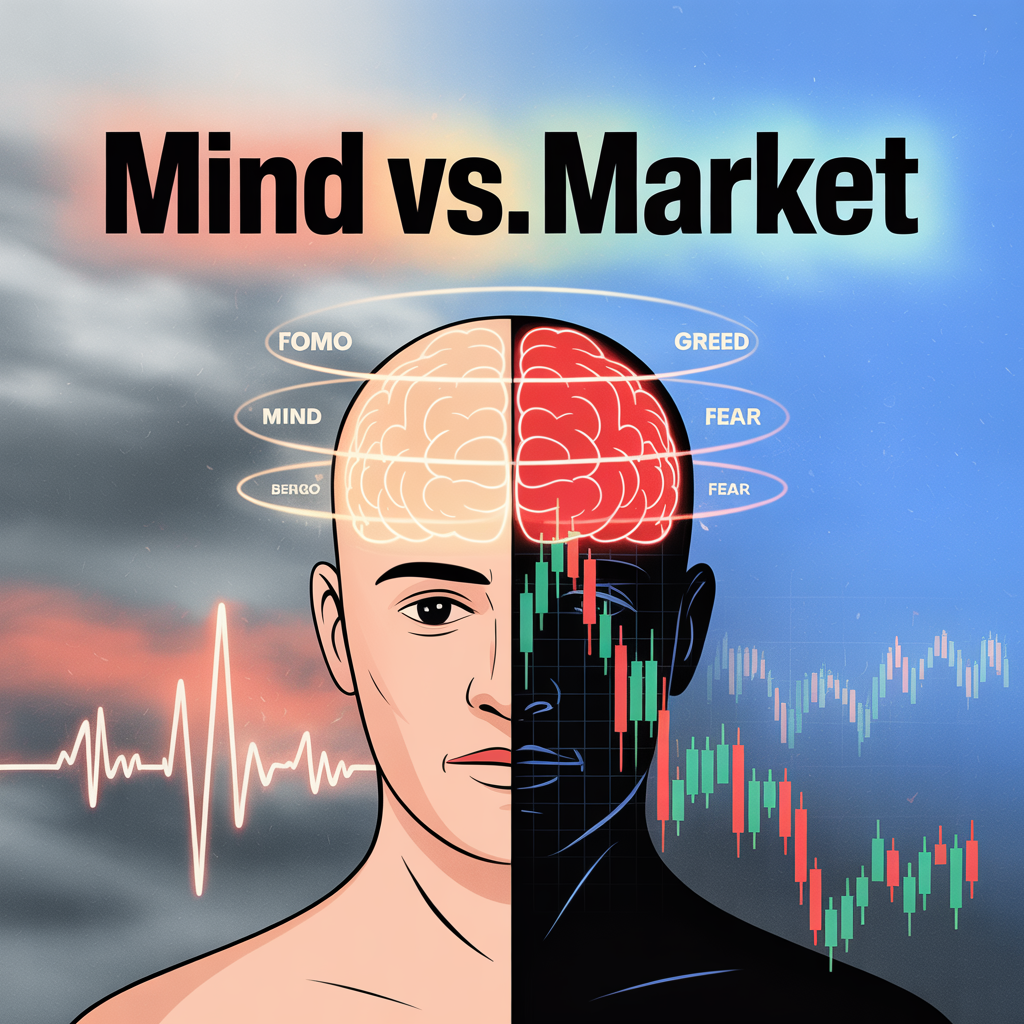
The human brain evolved over millions of years to survive in the jungle, not on Dalal Street. The psychological traits that kept our ancestors alive—following the herd, avoiding immediate pain, and seeking quick dopamine hits—are the exact same traits that will completely destroy a Demat account.
When a retail trader complains that the market is "manipulated" against them, they are missing the point. The market is just a mirror reflecting their own cognitive biases. Institutional algorithms don't have feelings; they simply exploit the predictable emotional reactions of the retail crowd.
Here is exactly why your brain forces you to make the worst possible decisions at the worst possible times.
1. The Dopamine Trap (Why We Buy High)
It has happened to everyone. You watch a stock surge 5%, then 10%, then 15% in a single week. You didn't buy it at the bottom. But the financial news channels are screaming about it, and your friends are bragging about their profits.
The Psychology: This is FOMO (Fear of Missing Out) combined with herd mentality. Your brain releases cortisol (stress) because you feel excluded from the tribe's success. To relieve that stress, your brain screams at you to hit "Buy."
The Institutional Exploitation: You hit "Buy" exactly when the stock reaches the top of its cycle. Who is selling you those shares? The institutional traders who bought the boring, quiet consolidation weeks ago. They are using your emotional FOMO surge as their exit liquidity. The moment you buy, the herd exhausts itself, and the stock crashes.
2. Prospect Theory & Loss Aversion (Why We Sell Low)
Once you buy at the top and the stock drops 10%, a new psychological nightmare begins: Loss Aversion.
Behavioral economists (like Daniel Kahneman) proved that the psychological pain of losing ₹10,000 is twice as intense as the joy of winning ₹10,000.
The Psychology of Holding Losers: When your stock drops, selling it means realizing the loss. It means admitting you were wrong. So, your brain protects your ego by holding on, hoping it bounces back. "It's not a loss if I don't sell." You turn a small 10% cut into a devastating 50% drawdown.
The Psychology of Selling Winners: Conversely, if you accidentally catch a good trade and it goes up 5%, you are terrified the market will take your small profit away. You sell immediately to lock in the dopamine hit, cutting your winners short.
The Result: You let your losers run forever and cut your winners immediately. This is the exact mathematical inverse of a profitable trading strategy.
3. Revenge Trading (The Death Spiral)
You finally accept the 50% loss and sell the stock at the absolute bottom. Now, you are angry. Your ego is bruised. You want to "make it back" from the market today.
The Mechanics: You abandon your risk management, increase your position size, and buy highly leveraged weekly options on a random index just to force a win. You have transitioned from trading to degenerate gambling.
The Fix: When you take a stop-loss, close the laptop. Do not look at the screen for 24 hours. The market will be there tomorrow; your capital will not be if you trade out of anger.
The Myth of "Trading Emotionless"
A common piece of advice for beginners is to "trade without emotion." This is biologically impossible. Unless you are an actual algorithm, watching ₹50,000 evaporate from your Demat account will cause a physiological stress response. Your heart rate will increase, and your adrenaline will spike.
Institutional traders do not eliminate emotions; they build mechanical barriers that prevent those emotions from executing trades. They shift their psychological focus away from money and entirely onto execution.
Here is the step-by-step blueprint to systematize your trading brain.
1. The "R-Multiple" (Thinking in Probabilities)
The human brain assigns emotional weight to currency. Losing ₹10,000 hurts. But what if you translated that ₹10,000 into a meaningless variable?
Professional traders use the "R-Multiple" system. "1R" simply equals your predefined, maximum acceptable risk per trade (e.g., 1% of your total capital).
The Mechanics: If your account is ₹10 Lakhs, your 1R is ₹10,000. When you look at a trade, you do not see a "₹30,000 profit." You see a "+3R" win. You do not see a "₹10,000 loss." You see a "-1R" loss.
The Psychological Edge: By converting rupees into abstract units of risk (R), you completely detach your ego and your living expenses from the trade. It becomes a sterile mathematical game of balancing your R-distribution.
2. The Pre-Trade Checklist
FOMO (Fear of Missing Out) strikes fast. You see a green candle surging, and your finger twitches toward the "Buy" button. You need a circuit breaker.
The Execution: Before you are allowed to execute a single order, you must physically check off a written Pre-Trade Checklist.
Is the price above the 200-Day Moving Average?
Is the Nifty broader trend aligned with my trade?
Have I calculated my exact 1R stop-loss level?
Is the Reward-to-Risk ratio at least 2:1?
The Reality: The 60 seconds it takes to read and verify this checklist is usually enough time for the emotional dopamine spike to fade. If the trade doesn't meet all criteria, the checklist forbids the entry. You outsource your discipline to the paper.
3. The "Kill Switch" (Daily Drawdown Limits)
Revenge trading happens when a trader takes two losses in a row, gets angry, and decides to increase their position size to win it all back in one shot.
The Defense: You must establish a Daily Drawdown Limit. For example, a "-2R" limit. If you lose two trades in a single day, you are mathematically done.
The Enforcement: Many modern brokers allow you to activate a "Kill Switch" in your account settings. Once your account hits a specific loss threshold for the day, the broker physically locks you out of the F&O segment until the next morning. Use technology to protect you from yourself.
Conclusion: Become the Machine
To win on Dalal Street, you must actively fight millions of years of human evolution. You must train yourself to feel uncomfortable. Buy when the chart is boring and the crowd is silent. Sell when the crowd is euphoric. And when the math says the trade is invalid, take the small loss immediately without a second thought. Build the system, trust the system, and fire the emotional human in your head.
💡 The Institutional Numbness:
Pros feel zero emotion over wins or losses. Treat trading like a factory where a loss is just a standard business expense. Systematize your rules until execution becomes absolutely boring.
The market does not know you exist. It does not care about your hopes, your financial goals, or your need to be "right." The moment you attach your self-worth to a trade, you have already lost.