Turn Yesterday's Crash into Tax Savings: Early Tax-Loss Harvesting for FY27
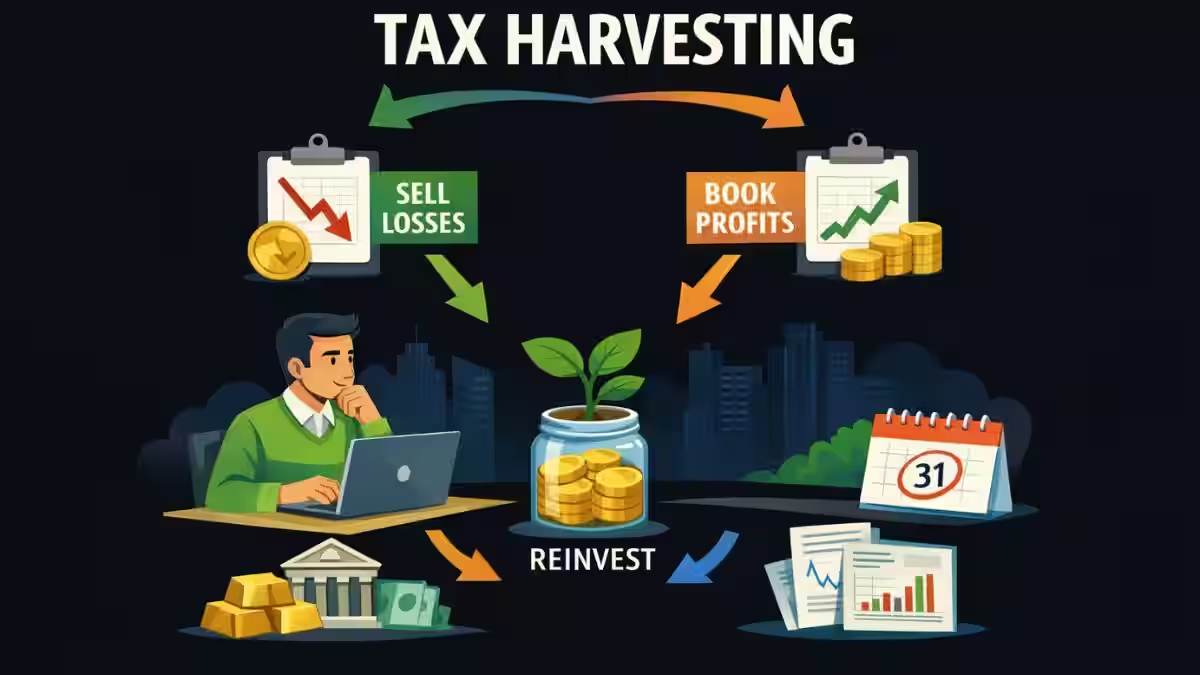
When a geopolitical shock or FII exodus turns your portfolio red, retail traders close their apps in disgust. Institutional quants open their spreadsheets. A market crash is the ultimate opportunity to execute Tax-Loss Harvesting. Don't wait until March 2027 to manage your taxes. Discover how to strategically book losses, offset your 20% STCG liability, and immediately rotate capital back into the market.
The Amateur March Rush vs. The Pro Crash Harvest
In the Indian stock market, amateurs think about taxes in the second week of March. They frantically look through their Demat accounts, trying to find losing stocks to sell before the March 31st financial year-end to offset their gains.
By March, the market might be at an all-time high, and those losses might have vanished.
Institutional traders execute Tax-Loss Harvesting dynamically, all year round. When a $100 oil shock or a Monday gap-down crashes the market, they don't panic. They view the sudden, temporary drop in their portfolio as a golden opportunity to lock in artificial losses and legally erase their tax liabilities for the rest of FY27.
1: The Mathematics of Harvesting
Following the recent Indian budget revisions, Short-Term Capital Gains (STCG) are taxed at 20%, and Long-Term Capital Gains (LTCG) are taxed at 12.5%. Tax-loss harvesting is the process of deliberately selling a stock at a loss to cancel out the profit of a winning stock, thereby reducing your net taxable income.
The Scenario: Earlier this year, you booked a ₹2,00,000 profit on a swing trade in Tata Motors. You now owe the government ₹40,000 in STCG tax (20%).
The Crash Opportunity: The market crashes. A separate IT stock you hold drops heavily, putting you at a ₹1,50,000 unrealized loss. The stock is fundamentally broken.
The Execution: You hit "Sell" on the IT stock. You realize the ₹1,50,000 loss. Your net taxable STCG is now only ₹50,000 (₹2L Gain - ₹1.5L Loss). Your tax bill instantly drops from ₹40,000 to ₹10,000. You just saved ₹30,000 in hard cash.
2: The "T+1" Settlement Trap
You sold the IT stock and harvested the loss. But what if you still believe in the IT sector and want to keep your capital invested? Can you just buy the exact same stock back five minutes later?
The Trap: While India does not have a strict "Wash Sale Rule" like the United States (which forbids buying the same stock within 30 days), Indian tax authorities can classify intraday buy-backs as speculative trading rather than capital gains/losses. Furthermore, under the T+1 settlement cycle, buying and selling the same stock on the same day nets out your position, meaning the delivery loss is never actually booked.
The Execution Rule: To cleanly harvest a loss, you must wait for the delivery to settle. Sell the stock on Monday. Let it exit your Demat account. Buy it back on Wednesday.
3: The Correlated Asset Rotation
If you don't want to be out of the market for two days waiting for settlement, you use Correlated Rotation.
The Logic: You want to harvest a loss in HDFC Bank, but you are terrified that the Bank Nifty will rally while you wait the two days to buy it back.
The Execution: You sell HDFC Bank to book the massive tax loss. In the exact same second, you buy an equivalent amount of ICICI Bank or a Bank Nifty ETF (BankBees).
The Edge: You have successfully booked the tax loss, but your capital remains 100% exposed to the banking sector's recovery. You haven't missed a single point of the bounce, and you legally secured your tax alpha.
The Multi-Year Tax Shield
In Part 1, we covered the basics of harvesting a ₹1,00,000 loss to offset a ₹1,00,000 Short-Term Capital Gain (STCG). But what if the market crash was brutal, and you harvested a massive ₹5,00,000 loss, but you only have ₹1,00,000 in gains this year?
The remaining ₹4,00,000 does not disappear. It becomes an Institutional Tax Shield.
Under Indian tax law, you are legally allowed to "carry forward" your unadjusted capital losses for up to 8 consecutive assessment years. This means that by aggressively harvesting a massive loss during a bear market today, you can legally trade tax-free for years into the future.
Here is how you structure and defend your multi-year tax shield.
1: The Cross-Asset Harvesting Pivot
A common retail misconception is that equity losses can only offset equity gains. This is completely false. Capital gains are treated holistically by the Income Tax Department based on their duration (Short-Term vs. Long-Term), not the underlying asset type.
The Setup: You harvested a massive Short-Term Capital Loss (STCL) in the Nifty IT index during the crash.
The Pivot: Later in the year, you decide to sell your physical gold, Gold ETFs, or Debt Mutual Funds for a massive profit.
The Execution: Because Short-Term Capital Losses (STCL) can be set off against any Short-Term Capital Gain (STCG) or Long-Term Capital Gain (LTCG), you can use your tech stock losses to completely wipe out the tax liability on your Gold or Debt profits. This cross-asset arbitrage is a staple of High Net Worth (HNI) portfolio management.
2: The LTCL Quarantine Rule
While STCL is incredibly flexible, Long-Term Capital Losses (LTCL) are heavily restricted. You must understand the "Quarantine Rule" before you hit the sell button.
The Rule: Long-Term Capital Losses (LTCL) can only be set off against Long-Term Capital Gains (LTCG). They cannot be used to offset your fast-paced swing trading (STCG) profits.
The Strategy: If you are managing a delivery portfolio and a stock crashes, try to harvest the loss before it crosses the 1-year holding period. A loss booked at 11 months (STCL) is vastly superior and more flexible for tax planning than a loss booked at 13 months (LTCL).
3: The "Voided Shield" Trap (Timely Filing)
This is the single biggest mistake retail traders make, and it costs them millions of rupees in lost tax shields.
The Law: To legally carry forward your capital losses to the next financial year, you must file your Income Tax Return (ITR) on or before the original due date (typically July 31st for individuals without an audit requirement).
The Trap: If you file a "Belated Return" even one day late (e.g., August 1st), the Income Tax Department will accept your return, but they will permanently void your right to carry forward those losses. Your multi-year tax shield will be instantly deleted.
Execution Rule: If you harvested losses this year, your ITR filing date is an uncompromising, hard deadline.
Conclusion: Act While the Blood is in the Streets
A market crash is painful, but wasting a market crash is unforgivable. Stop staring at your unrealized losses hoping they bounce back. Audit your booked profits for FY27, identify the fundamental laggards in your portfolio, and ruthlessly harvest them. Rotate the capital into correlated ETFs to catch the recovery, and let the government finance your next trade.
💡 The Set-Off Rules:
Short-Term Losses (STCL) offset both STCG and LTCG, but Long-Term Losses (LTCL) offset only LTCG. Prioritize harvesting short-term losses for maximum tax flexibility.
A ₹1,00,000 unrealized loss in a fundamentally weak stock is a tragedy. A ₹1,00,000 realized loss used to offset a ₹1,00,000 Short-Term Capital Gain (STCG) is a brilliant tax maneuver that literally hands you ₹20,000 in cash savings.