
Beyond AI: Why India's Green Energy Sector is Gearing Up for a Massive FY27 Breakout
While the world is fixated on the AI revolution, a more tangible shift is happening in India’s power grids. As crude oil hovers at $115, we analyze why policy shifts, PLI schemes, and the Green Hydrogen Mission are aligning for a massive sectoral breakout in the coming fiscal year.
While the initial hype of the 2024-2025 AI bull run has begun to stabilize, a more fundamental transformation is quietly accelerating in India’s industrial heartlands. As we approach Fiscal Year 2027 (FY27), the narrative on Dalal Street is shifting from "digital intelligence" to "energy sovereignty." The convergence of high crude oil prices, aggressive government mandates, and technological maturity is positioning the renewable energy sector for a multi-year breakout.
The Architecture of the FY27 Breakout: Beyond the Hype
While the 2024-2025 period was characterized by "announcements" and "Memorandums of Understanding (MoUs)," FY27 marks the transition to Execution and Earnings. The market is no longer valuing these companies on potential; it is valuing them on gigawatts connected to the grid and the falling cost of the Levelized Cost of Energy (LCOE).
1. The Energy Storage Revolution (BESS & Pumped Hydro)
The "intermittency problem"—the fact that solar doesn't work at night—is being solved by massive investments in Battery Energy Storage Systems (BESS). In FY27, India is expected to commission its first 10GWh scale battery storage projects.
This shift is critical for Dalal Street because it transforms "unreliable" renewable energy into "firm, dispatchable power," allowing green energy players to compete directly with coal-fired plants on pricing and reliability. For the first time, we are seeing Grid Parity, where the cost of renewable energy plus storage is lower than the cost of new thermal power.
2. The Rise of the "Green Hydrogen" Ecosystem
Green Hydrogen is the "holy grail" of the FY27 breakout. By using surplus renewable energy to split water molecules, India is creating a zero-carbon fuel for heavy industries.
Refinery Integration: India’s massive public sector refineries are mandated to replace 10% of their grey hydrogen with green hydrogen by 2027.
Export Potential: With Europe and Japan looking to diversify away from Russian gas and Middle Eastern oil, India is positioned as a low-cost exporter of Green Ammonia, providing a massive boost to the Current Account Deficit (CAD).
"The math is simple: If India can reduce its energy import bill by just 20% through domestic green hydrogen, the Rupee stabilizes, inflation cools, and the valuation multiples for the entire utility sector re-rate upward." — Global Institutional Investor Brief, March 2026
The $115 Oil Catalyst: From Crisis to Opportunity
The persistent volatility in the Middle East has kept Brent Crude above the $110–$115 per barrel range for much of early 2026. For India, this isn't just a headline; it is a direct hit to the national balance sheet.
This "Crude Shock" has served as the ultimate catalyst for the National Green Hydrogen Mission. In FY27, we expect to see the first wave of commercial-scale green hydrogen plants go operational, significantly reducing the carbon footprint of "hard-to-abate" sectors like steel and fertilizers.
The "Smart Grid" Synergy: Where AI Meets Renewables
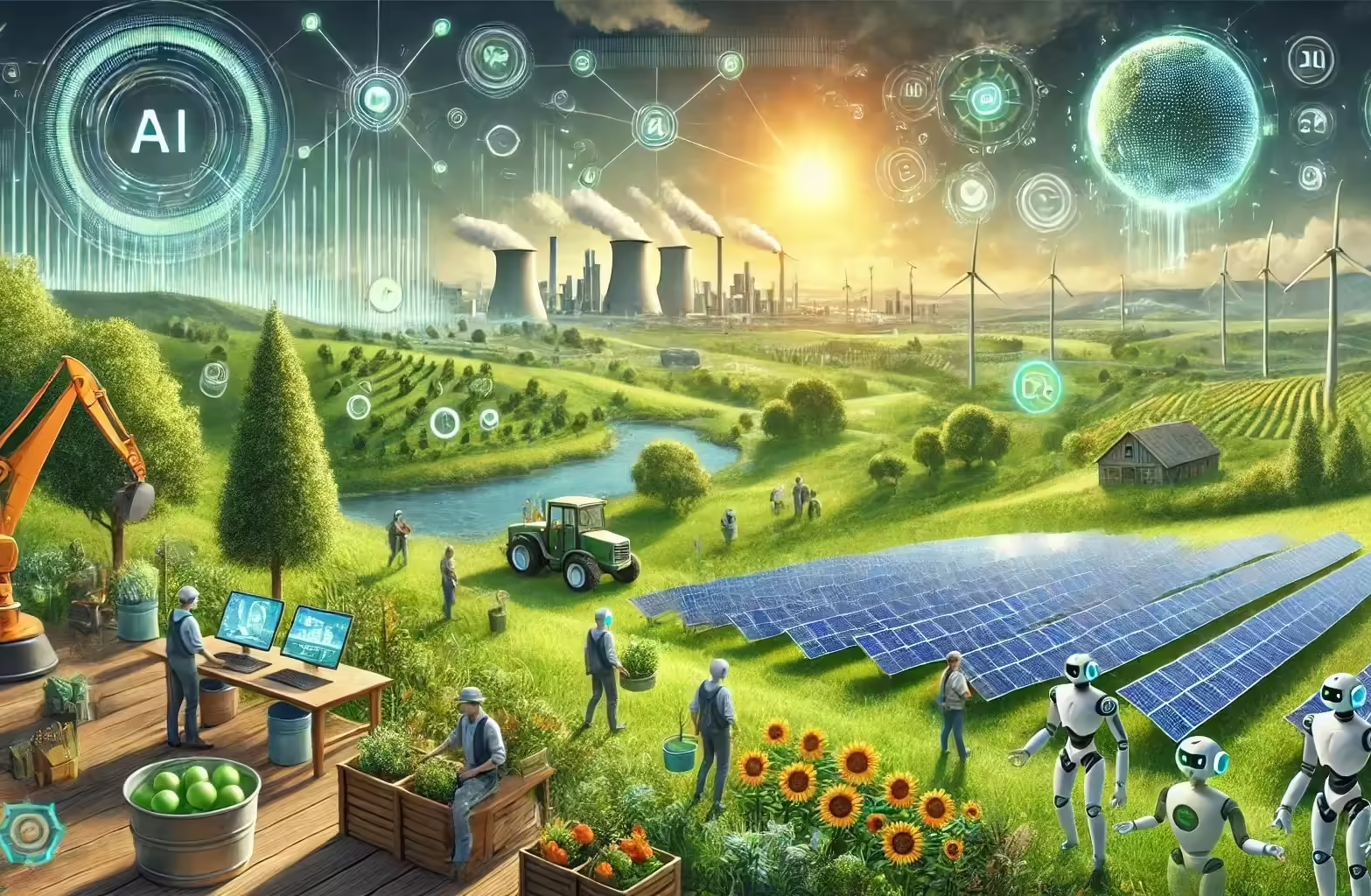
The image above perfectly illustrates the next phase of this revolution: AI-Integrated Energy Systems. One of the biggest hurdles for solar and wind power has always been intermittency—the sun doesn't always shine, and the wind doesn't always blow.
In FY27, AI is solving this through:
Predictive Load Balancing: Machine learning algorithms now predict weather patterns and grid demand with 98% accuracy, allowing for seamless switching between battery storage and active generation.
Automated Solar Maintenance: As shown in the futuristic "Smart Farm" visuals, AI-driven drones and robotics are reducing the operational cost (O&M) of massive solar parks by nearly 30%.
"Data centers are the new oil refineries of the 21st century, but they run on electrons. In FY27, the companies providing the 'Green Electrons' to power India's AI ambitions will be the new market leaders." — Strategic Investment Outlook 2026
Policy Tailwinds: The FY27 Manufacturing Surge
The government's Production Linked Incentive (PLI) schemes for solar modules and Advanced Chemistry Cell (ACC) batteries are reaching a critical "inflection point" this year.
By the start of FY27, India is projected to become a net exporter of solar components, breaking the decade-long reliance on external supply chains. This shift protects Indian energy companies from the currency devaluation (Rupee at 91.30+) that is currently hurting other import-heavy sectors.
Metric | FY25 Actuals | FY27 Projections | Investment Impact |
Solar Installed Capacity | ~90 GW | ~150 GW | Infrastructure Boom |
EV Adoption (2-Wheelers) | 15% | 35% | Battery Demand Surge |
Green Hydrogen Cost | $5/kg | $2.5/kg | Industrial Viability |
The "Alpha" Conclusion: Why Wait for FY27?
Stock markets are forward-looking mechanisms. They typically price in a breakout 6 to 9 months before it appears in the quarterly earnings reports. With the $115 oil crisis acting as a forced accelerant, the "smart money" is already rotating out of high-PE tech stocks and into the "picks and shovels" of the green transition.
For the retail investor, the message is clear: The volatility of early 2026 is a distraction. The real wealth creation of the decade lies in the infrastructure that powers the "Beyond AI" era.
⚡ The FY27 "Green Parity" Inflection Point
By April 2026, India may reach solar + storage grid parity, making renewable energy cheaper than coal. With rising oil prices and 100GW solar capacity, FY27 could mark the rise of “Green Alpha,” where renewable stocks outperform traditional energy.
Real-time smart-grid monitoring is the backbone of India’s FY27 breakout. By integrating solar and wind data, engineers are ensuring a stable, high-capacity grid that effectively hedges against global fossil fuel volatility.