Q4 Banking Blockbusters: What HDFC and ICICI’s Numbers Mean for Bank Nifty
You cannot trade the Bank Nifty if you do not understand the balance sheets of HDFC and ICICI Bank. Together, these two giants dictate over 50% of the index's movement. Dive into their Q4 FY26 earnings to understand the battle between HDFC's post-merger Credit-Deposit ratio and ICICI's pristine asset quality, and learn how to position your options trades accordingly.
The Engine Room of the Indian Market
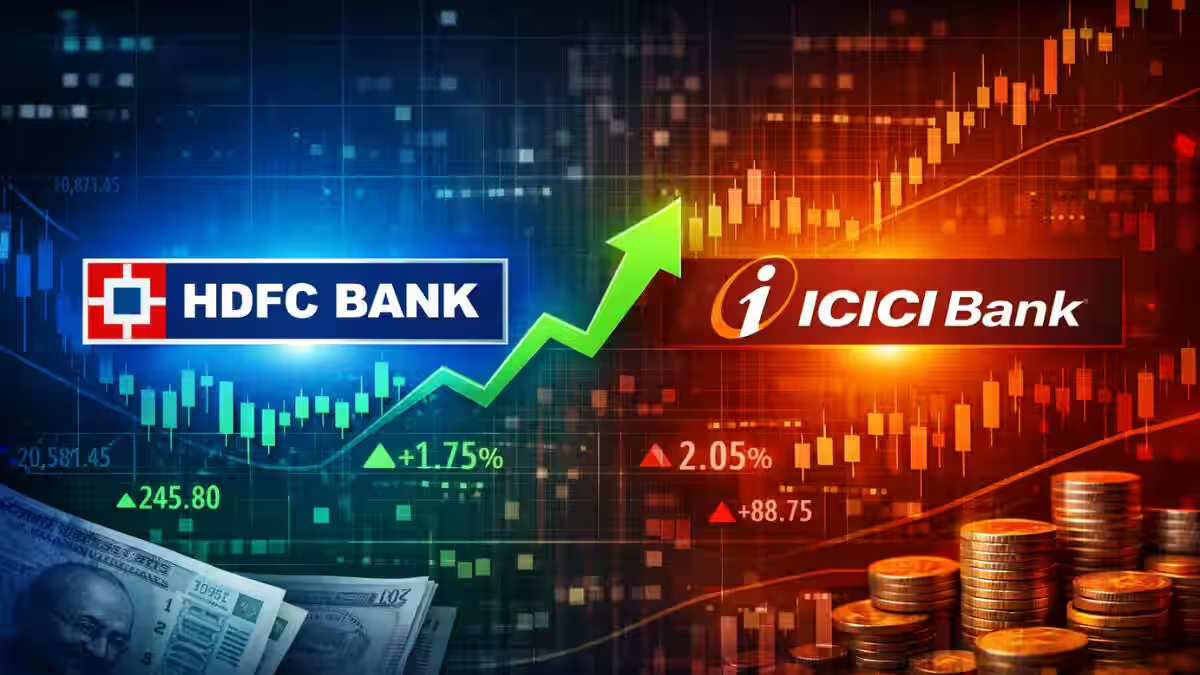
If you trade Bank Nifty options, you are essentially trading a derivative of two massive balance sheets. In 2026, HDFC Bank and ICICI Bank combined control more than half of the Bank Nifty's total weightage.
When Q4 earnings season arrives, the macro-economic noise fades, and the market ruthlessly focuses on the fundamental truth of these two institutions. If HDFC and ICICI align—either both surging or both crashing—the Bank Nifty will print a 1,000-point trending day. If they diverge, the index becomes a sideways, option-premium-destroying trap.
The Earnings Week Minefield
We established that HDFC Bank and ICICI Bank control over 50% of the Bank Nifty's movement. When Q4 earnings week arrives, retail traders flood the market, blindly buying At-The-Money (ATM) Calls if they expect good results, or ATM Puts if they expect bad ones.
This is financial suicide.
During earnings week, Implied Volatility (IV) expands massively. The market prices in a large move, meaning the options premiums you are buying are artificially inflated. The moment the earnings are announced—even if the results match your prediction—the uncertainty vanishes. IV collapses, and your options lose 40% of their value in minutes. This is the dreaded "IV Crush."
To survive Bank Nifty earnings, you must stop trading the direction and start trading the volatility.
Strategy 1: The Pre-Earnings Iron Condor (The Chop Play)
What happens when HDFC Bank reports its numbers on Saturday, and ICICI Bank reports on Sunday? On Monday morning, if HDFC's numbers are poor but ICICI's are stellar, the Bank Nifty index will be paralyzed. It will chop violently sideways as the two heavyweights cancel each other out.
The Setup: An Iron Condor is a non-directional strategy designed to profit from a sideways market and an IV crush.
The Execution: Before the earnings are released (when IV is highest), you sell a far Out-of-the-Money (OTM) Call and buy a further OTM Call for protection. Simultaneously, you sell a far OTM Put and buy a further OTM Put.
The Mathematical Edge: You are defining a massive "safe zone." As long as the Bank Nifty does not explode past your upper or lower strikes, the inflated premiums you sold will rapidly decay. When the market opens flat on Monday due to the heavyweight divergence, you close the position for a pure volatility profit.
Strategy 2: The Post-Earnings Directional Fly
If both HDFC and ICICI report massive beats on their Net Interest Margins (NIMs), the Bank Nifty is going to trend hard. But after the morning gap-up, buying naked Calls is still dangerous because of the IV crush.
The Setup: Enter the Call Butterfly Spread. This is a highly calculated, low-risk directional play.
The Execution: You buy 1 In-The-Money (ITM) Call, sell 2 At-The-Money (ATM) Calls, and buy 1 Out-of-The-Money (OTM) Call.
The Edge: Because you are selling two ATM options (where the premium is highest), you drastically reduce the cost of your directional bet. Your maximum profit is achieved if the Bank Nifty slowly grinds up to your short strikes by expiry. It is the perfect institutional vehicle for a post-earnings drift.
Strategy 3: The PSU Sympathy Play (SBI Correlation)
Sometimes, the private sector giants suck all the liquidity out of the options chain, making the spreads too wide to trade safely. When this happens, professional traders look at State Bank of India (SBI).
The Logic: If ICICI Bank reports a massive cleanup in corporate NPAs (Non-Performing Assets), it acts as a leading macroeconomic indicator for the entire banking sector. If ICICI's corporate loan book is pristine, SBI's corporate loan book is likely pristine as well.
The Execution: Instead of fighting the high IV in Bank Nifty options, you execute directional trades on SBI (or PSU Bank Bees) before SBI actually reports its own earnings, front-running the positive sector-wide sentiment generated by the private heavyweights.
HDFC Bank: The Post-Merger Digestion
Ever since the mega-merger with its parent entity (HDFC Ltd.), the market has been punishing HDFC Bank's stock. The Q4 FY26 earnings report is the ultimate litmus test to see if the elephant has finally digested the meal.
The Key Metric to Watch: The Credit-Deposit (CD) Ratio
The Problem: The merger gave HDFC Bank a massive loan book (Credit) but didn't magically give them an equivalent amount of low-cost CASA (Current Account Savings Account) deposits. This pushed their CD Ratio to uncomfortably high levels, forcing them to borrow expensive wholesale funds to maintain liquidity.
The Q4 Reality Check: The market is obsessively watching their deposit growth. If HDFC reports that they successfully aggressively raised retail deposits in Q4 without destroying their Net Interest Margins (NIMs), the stock will violently re-rate upwards.
The Trading Verdict: If HDFC shows a cooling CD ratio and stabilizing margins, it triggers a massive short-covering rally. Because HDFC holds a ~29% weightage in the index, this alone can drag the Bank Nifty out of any bearish channel.
ICICI Bank: The Pristine Compounder
While HDFC has been struggling with merger physics, ICICI Bank has spent the last few years quietly becoming the darling of Foreign Institutional Investors (FIIs).
The Key Metric to Watch: Asset Quality and Provisioning
The Strength: ICICI operates with ruthless efficiency. Their Q4 numbers are expected to showcase industry-leading NIMs and a beautifully clean loan book with Gross NPAs (Non-Performing Assets) trending toward historic lows.
The Valuation Trap: Because ICICI has been executing so perfectly, it is priced for perfection. The market expects blockbuster numbers. If they deliver great numbers, the stock might just stay flat. If they show even a tiny crack in unsecured retail lending defaults, the market will punish the premium valuation severely.
The Trading Verdict: ICICI (with its ~23% weightage) acts as the stabilizer. If ICICI holds its ground while HDFC recovers, the Bank Nifty is primed for a new all-time high.
Execution: How to Trade the Bank Nifty This Week
Professional traders do not guess earnings outcomes; they trade the volatility crush and the structural trend after the numbers are out.
Watch the First 30 Minutes: Let the institutional algorithms fight it out at the 9:15 AM open. The initial move is often a fake-out designed to trigger retail stop-losses.
The "Alignment" Strategy: Open a split-screen layout with HDFC Bank on the left, ICICI Bank in the middle, and Bank Nifty on the right. Do not execute a directional Bank Nifty trade unless both HDFC and ICICI are trending in the same direction.
Exploit the IV Crush: If you expect a massive move but IV is too high to buy naked options, execute a Call/Put Debit Spread. This caps your profit but significantly reduces the premium you pay, making you immune to the post-earnings volatility crush.
Conclusion: Respect the Math
The Bank Nifty is not an abstract entity; it is a weighted mathematical formula. By deeply understanding the specific Q4 operational hurdles of HDFC Bank (Deposit Growth) and ICICI Bank (Asset Quality), you stop trading blind chart patterns and start trading the actual fundamental mechanics of Dalal Street.
💡 The Divergence Trap:
If HDFC and ICICI move in opposite directions, the Bank Nifty will chop sideways. Stop buying options and switch to selling Iron Condors or Strangles to harvest theta decay.
Stop drawing trendlines on the Bank Nifty index chart without looking at the heavyweights. A breakout on the index is mathematically guaranteed to fail if HDFC and ICICI are facing heavy selling pressure on their individual charts.