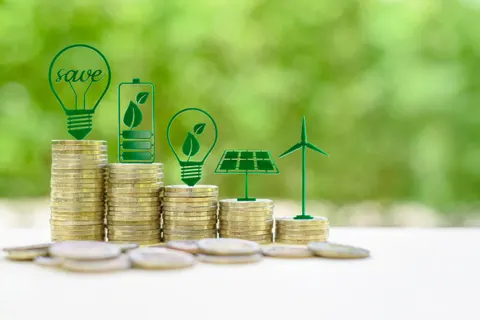
The Green Energy Boom: 3 Sectors to Watch for Long-Term Growth
India's transition to 500 GW of renewable energy by 2030 is no longer just an environmental goal; it is a generational wealth-building event. Discover the top three green sectors—Solar Infrastructure, Battery Storage, and Green Hydrogen—that are poised for massive long-term breakouts.
The Era of "Climate Alpha"
For years, investing in "Green Energy" was seen as an ESG (Environmental, Social, and Governance) mandate—something funds did to look good on paper, often sacrificing returns. By 2026, the narrative has entirely flipped. Clean energy is now strictly about economics and national security.
With India heavily reliant on crude oil imports, the government’s aggressive push toward energy independence has created a massive tailwind for domestic companies. We are entering the era of "Climate Alpha," where the biggest market outperformers will be the companies solving the energy transition.
Here are the three specific green energy sectors you need to watch for long-term portfolio growth.
Solar Infrastructure & Grid Modernization
The headline target is clear: 500 GW of non-fossil fuel capacity by 2030. To get there, India is adding solar capacity at a blistering pace, supported by schemes like PM Surya Ghar Muft Bijli Yojana.
However, the real money isn't just in the companies generating the power; it’s in the infrastructure required to capture and transport it.
Solar Module Manufacturers: With strict import duties on Chinese solar panels, domestic manufacturers (like Waaree Energies and Premier Energies) are seeing record-breaking order books.
EPC (Engineering, Procurement, and Construction): Companies like Tata Power and L&T that actually build these massive solar parks are the "picks and shovels" of the green gold rush.
Grid Upgraders: You cannot push 500 GW of intermittent solar power through a 20th-century grid. Companies manufacturing high-voltage transformers and smart meters are critical to this transition.
The EV Ecosystem & Advanced Battery Storage
The Electric Vehicle (EV) narrative has matured. Investors are moving past the hype of EV startups and focusing on the underlying infrastructure that makes electric mobility possible.
Battery Cell Manufacturing: Thanks to the government's Advanced Chemistry Cell (ACC) PLI scheme, legacy lead-acid battery makers (like Exide and Amara Raja) are aggressively pivoting to lithium-ion gigafactories. The company that successfully localizes cell manufacturing will dominate the decade.
Charging Infrastructure: Range anxiety remains the biggest hurdle for EV adoption in India. Power companies and conglomerates rolling out nationwide fast-charging networks are building a recurring revenue model similar to traditional petrol pumps.
Automotive OEMs: Traditional heavyweights like Tata Motors and Mahindra & Mahindra continue to leverage their massive distribution networks to out-price and out-scale pure-play EV startups.
"In the green energy boom, don't just look for the electric car; look for the company that owns the battery patent and the charging cable."
Green Hydrogen (The Heavy Industry Savior)
While solar and batteries are great for homes and cars, they cannot power massive steel plants, cement factories, or commercial shipping. Enter Green Hydrogen.
Green Hydrogen is produced by splitting water using renewable electricity. It is the only viable way to decarbonize India's heavy industries.
The Catalysts: The National Green Hydrogen Mission has allocated nearly ₹20,000 Crore to make India a global hub for production and export.
The Players: This is a capital-intensive game dominated by the giants. Reliance Industries, Adani Enterprises, and L&T are investing billions in electrolyzer manufacturing and green hydrogen production facilities.
The Timeline: While Solar and EVs are generating revenues today, Green Hydrogen is a high-conviction play for the 2028-2030 timeline.
The Risk/Reward Matrix
Sector | Current Market Phase | Investment Horizon | Risk Level |
Solar & Grid Infra | Execution & Scaling | 3 - 5 Years | Moderate |
EV Ecosystem & Storage | Rapid Adoption | 5 - 7 Years | Moderate to High |
Green Hydrogen | R&D and Early Capex | 7 - 10+ Years | High |
Conclusion: Don't Buy the Buzzword
The green energy boom will inevitably have its "dot-com bubble" moments where companies with zero earnings trade at astronomical valuations simply because they have "Solar" or "Green" in their name.
As a long-term investor, your job is to filter the noise. Look for companies with strong order books, government PLI backing, and a clear path to profitability. The transition to clean energy is inevitable, and the wealth created along the way will be historic.
💡 Pro-Investor Tip: Beware the "Greenwash" Trap
Many legacy companies are rebranding themselves as sustainable without fundamentally changing their revenue streams. Always check the CAPEX. If a company isn't spending at least 20% of its CAPEX on green initiatives, their "green" pivot is likely just PR.
The green transition is a multi-decade supercycle. Use SEBI’s T+0 settlement to swiftly reallocate capital from legacy fossil-fuel heavyweights into high-growth renewable energy leaders.