Can Full-Time Traders Actually Claim Section 80C Deductions?
A dangerous myth exists on Dalal Street: that only salaried employees can claim the ₹1.5 Lakh Section 80C tax deduction. The truth is much more complex. Learn the exact legal framework that allows full-time F&O traders to claim 80C, and discover the fatal "Special Rate Income" trap that prevents equity investors from doing the same.
The "Salaried Only" Myth
If you transition from a 9-to-5 IT job to full-time trading, your Chartered Accountant might casually mention that your tax planning is going to change. Many retail traders misinterpret this to mean that the holy grail of tax savings—Section 80C (PPF, ELSS, Life Insurance)—is no longer available to them.
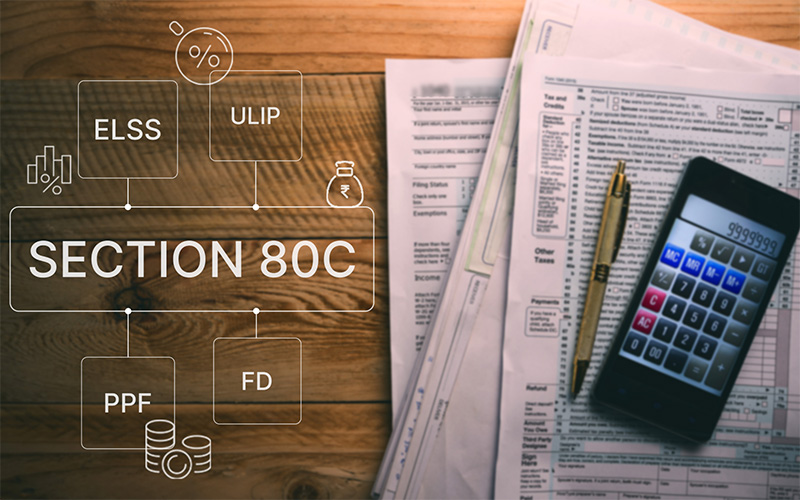
This is fundamentally incorrect. Section 80C is available to any Individual or Hindu Undivided Family (HUF), regardless of whether they earn their money from a corporate salary, a retail shop, or by trading BankNifty.
However, the Income Tax Department applies strict mathematical walls based on how your Dalal Street profits are classified.
Scenario A: The F&O and Intraday Trader (Business Income)
If your primary source of income is Futures & Options (Non-Speculative) or Intraday Cash Trading (Speculative), you are legally operating a business.
The Law: Your trading profits are added to your Gross Total Income and taxed at standard slab rates.
The 80C Verdict: YES. Because business income is taxed at normal slab rates, you are legally permitted to claim the full ₹1.5 Lakh Section 80C deduction (along with 80D for health insurance) to directly reduce your net taxable F&O profits.
The Math: If your net F&O profit is ₹10 Lakhs, and you invest ₹1.5 Lakhs in PPF, your taxable income drops to ₹8.5 Lakhs.
Scenario B: The Swing Trader & Investor (Capital Gains)
This is where 90% of retail traders make a catastrophic error during tax filing. If you only trade equity delivery (buying shares and holding them for days, months, or years), your profits are classified as Capital Gains.
The Law: Short-Term Capital Gains (STCG under Section 111A) and Long-Term Capital Gains (LTCG under Section 112A) are classified as "Special Rate Incomes." The government already taxes them at a flat, preferential rate (20% for STCG and 12.5% for LTCG in 2026).
The 80C Verdict: NO. Under Chapter VI-A of the Income Tax Act, you cannot claim Section 80C, 80D, or any other deduction against Special Rate Incomes.
The Trap: If you make ₹5 Lakhs in STCG and have zero other income, investing ₹1.5 Lakhs in an ELSS fund will not reduce your tax bill. You will still pay the flat 20% on the entire ₹5 Lakhs. Your 80C investment was legally useless for tax-saving purposes.
Moving Beyond the ₹1.5 Lakh Ceiling
In Part 1, we established that if you operate an F&O or Intraday trading business under the Old Tax Regime, you are legally entitled to claim Section 80C against your business profits (though never against your Capital Gains).
But for a highly profitable trader, a ₹1.5 Lakh deduction is simply not enough to move the needle against the 30% tax slab. Furthermore, when you leave a 9-to-5 job to trade full-time, you lose two massive financial shields: Corporate Health Insurance and Employer Provident Fund (EPF) matching.
To survive and compound your wealth, you must utilize the outer edges of Chapter VI-A of the Income Tax Act to rebuild those shields yourself.
Strategy 1: The Section 80CCD(1B) "Alpha Extension"
Many traders max out their ₹1.5 Lakh 80C limit (via PPF, ELSS, or Life Insurance) and assume their tax-saving journey is over. They leave ₹50,000 of free tax deductions on the table every single year.
The Law: Section 80CCD(1B) provides an additional, exclusive deduction of ₹50,000 specifically for voluntary contributions to the National Pension System (NPS) Tier-1 account. This is completely separate from the 80C limit.
The Trader's Edge: As a full-time trader, you do not have an employer depositing money into an EPF account for your retirement. The NPS acts as your mandatory retirement lock-box. By depositing ₹50,000 into an aggressive Auto-Choice NPS fund (which allocates up to 75% to equity), you are forcing a portion of your trading alpha into a tax-deferred retirement vehicle, instantly saving up to ₹15,600 in taxes if you are in the 30% slab.
Strategy 2: The Section 80D Health Fortress
A single hospitalization can trigger a psychological spiral that destroys a trader's discipline and blows up their margin account. A comprehensive health insurance policy is not optional; it is mandatory risk management. The ITD rewards you for this.
The Law (Section 80D): You can claim the premiums paid for health insurance as a direct deduction from your F&O business income.
The Math: * You can claim up to ₹25,000 for policies covering yourself, your spouse, and your dependent children.
You can claim an additional ₹50,000 if you pay the premiums for your senior citizen parents.
You can also claim up to ₹5,000 for preventive health check-ups (within the overall limits).
The Result: A full-time trader paying for comprehensive family and parental health cover can deduct a massive ₹75,000 from their taxable F&O profits.
Strategy 3: Education and Philanthropy (80E & 80G)
If you are scaling your income rapidly, look into these specialized deduction clauses:
Section 80E (Education Loans): If you took an education loan for yourself, your spouse, or your children, the entire interest component paid during the year is 100% tax-deductible without any upper limit. This is a massive shield for younger traders carrying student debt.
Section 80G (Charitable Donations): Dalal Street can be ruthless. Many successful traders offset their karmic and financial ledgers by donating to recognized funds (like the Prime Minister's National Relief Fund). These donations offer either a 50% or 100% deduction on the donated amount, directly reducing your taxable business income.
The Hybrid Reality (How to Optimize)
Most Dalal Street professionals do not trade just one instrument. They have a hybrid portfolio: perhaps ₹8 Lakhs in F&O profit and ₹4 Lakhs in STCG.
How does Section 80C work here? The ITD software will automatically subtract your ₹1.5 Lakh 80C deduction from your normal slab rate income (the F&O profit).
Your F&O profit drops from ₹8 Lakhs to ₹6.5 Lakhs.
Your STCG remains untouched at ₹4 Lakhs and is taxed at the flat 20%.
The "Zero Boundary" Rule
There is one final legal limit to understand. Section 80C deductions cannot bring your Gross Total Income below zero to create a "loss."
If you had a terrible trading year and your F&O business generated a net profit of only ₹50,000, but you invested ₹1.5 Lakhs into life insurance premiums, you cannot claim a ₹1 Lakh loss to carry forward. Your taxable business income simply becomes ₹0, and the remaining ₹1 Lakh of your 80C investment provides zero tax benefit.
Conclusion: Map Your Income Sources
A full-time trader absolutely can—and should—claim Section 80C deductions, provided two conditions are met: they are utilizing the Old Tax Regime, and they possess enough standard Business Income (F&O/Intraday) to absorb the deduction. Never attempt to shield Capital Gains with an 80C investment. Analyze your ledger in April, project your income classification, and deploy your capital exactly where the tax code allows.
💡 The "Cash" Trap in 80D:
If you want to claim your health insurance premium under Section 80D, you must pay via digital means, net banking, UPI, or cheque. If you pay your premium in physical cash, the Income Tax Department legally invalidates the deduction.
You are the CEO of your trading firm. Use the expanded Chapter VI-A deductions to build your own health and retirement safety nets, ensuring your F&O profits are protected from both medical emergencies and the Income Tax Department.