The Anatomy of a Drawdown: How to Recover from a Losing Streak
Every trader, from retail beginners to Dalal Street institutional quants, experiences a severe drawdown. But while amateurs revenge-trade their accounts to zero, professionals execute a mathematical recovery protocol. Learn the mechanics of the "Drawdown Spiral" and the exact 3-step SOP to rebuild your capital.
The Inevitability of the Drawdown
Let’s establish a fundamental truth about the 2026 Indian stock market: You will experience a drawdown. Whether you trade BankNifty options, swing trade mid-caps, or run automated Python algorithms, a losing streak is mathematically inevitable.
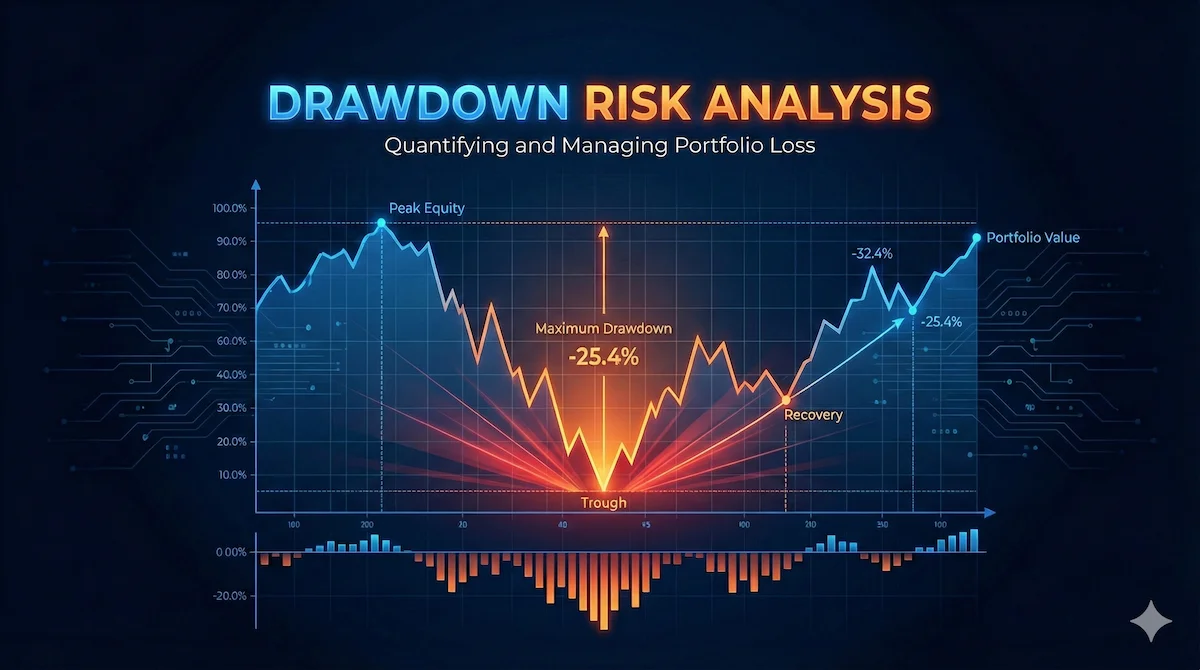
A drawdown is simply the peak-to-trough decline in your trading account. If your account hits ₹10 Lakhs and then drops to ₹8 Lakhs, you are in a 20% drawdown.
The difference between a trader who survives a decade and a trader who blows up in a month is not the absence of drawdowns; it is how they manage the recovery phase. Amateurs rely on "hopium" and revenge trading. Professionals rely on mathematics.
Understanding the 2026 Regulatory Framework
SEBI’s new guidelines are designed to eliminate the conflict of interest between unregulated creators and the brokers/platforms that sponsor them. Here are the three pillars of the new reality:
1. The Ban on Unregistered Advisory
SEBI has drawn a hard line: you cannot offer specific buy/sell recommendations, target prices, or personalized portfolio advice unless you are a SEBI-Registered Investment Advisor (RIA) or Research Analyst (RA).
The Loophole Closed: Previously, finfluencers used disclaimers like "This is for educational purposes only" while simultaneously charging ₹5,000 for a "Premium VIP Telegram Group." Under the 2026 rules, this disclaimer no longer protects creators from massive fines and market bans if they are caught distributing actionable trade setups behind a paywall.
2. The Profit-Sharing Ban (Copy Trading)
Algorithmic copy-trading platforms faced a severe existential threat. SEBI has heavily restricted "profit-sharing" models where unregulated strategy creators take a 20% cut of a retail investor's profits.
The Impact: Retail investors can still use automated execution platforms (like TradingView webhooks), but they must be the authors of their own code, or the strategies must be provided by explicitly registered entities.
3. The Sponsorship Firewall
Regulated entities (Stockbrokers, Mutual Funds, AMCs) are now strictly prohibited from associating with, sponsoring, or paying referral fees to unregistered finfluencers who cross the line into advisory.
The Impact: The massive "Account Opening" referral networks that funded the finfluencer boom have dried up. Content creators must now rely on standard YouTube AdSense or pivot to purely educational, non-actionable content.
The Mathematics of Recovery (The Hardest Truth)
The most dangerous aspect of a drawdown is the asymmetrical math required to recover from it. When you lose money, your capital base shrinks, which means you need a higher percentage return just to get back to breakeven.
Look at this Drawdown Recovery Matrix. Memorize it. Print it out and tape it to your monitor:
Account Drawdown | Capital Remaining | Return Required to Breakeven |
10% | 90% | 11.1% |
20% | 80% | 25.0% |
30% | 70% | 42.8% |
50% | 50% | 100.0% |
75% | 25% | 300.0% |
The Lesson: If you take a 50% hit to your account because you refused to cut a losing Zero-to-Hero trade on Expiry Day, you do not need to make 50% to recover. You have to double your remaining money (100% return) just to get back to where you started.
Phase 1: The Psychology of the Spiral
Drawdowns rarely happen because of one bad trade. They happen because of the "Drawdown Spiral."
The Initial Loss: You take a normal, system-generated loss.
The Ego Hit: You feel the need to "win it back" quickly.
Revenge Trading: You abandon your SOP. You increase your lot size (averaging down on losing options) to make the money back in one trade.
The Catastrophe: The market moves against your oversized position, triggering a massive, unrecoverable loss.
Phase 2: The 3-Step Recovery Protocol
If you are currently in a drawdown exceeding 15%, you must stop trading your normal system and execute the Recovery Protocol.
Step 1: The Circuit Breaker (Halt Trading)
The moment your drawdown hits your predefined threshold (e.g., -15%), you must enforce a hard stop.
Action: Close all positions. Turn off the terminal. Do not look at the BankNifty chart for at least 48 hours.
Why: You are compromised. Your brain is producing cortisol, making you risk-averse and irrational. You need a dopamine reset.
Step 2: Systemic vs. Psychological Audit
During your break, open your trading journal and ask one question: Is the system broken, or am I broken?
Systemic Drawdown: You followed your rules perfectly, but the market regime changed (e.g., India VIX spiked from 12 to 20, breaking your Iron Condor algorithm). Fix: Adjust the algorithm's parameters.
Psychological Drawdown: You broke your rules. You over-leveraged, moved your stop-loss, or traded on a hunch. Fix: You need stricter risk guardrails.
Step 3: The "Fractional Capital" Restart
When you return to the market, do not try to make the money back. If you try to force a 25% return to recover your capital, you will take excessive risks and blow the account entirely.
Action: Cut your lot size by 50% to 75%. If you normally trade 10 lots of BankNifty, you are now only allowed to trade 2 lots.
Goal: The goal is not P&L recovery. The goal is Confidence Recovery. You need to see three green trades in a row, even if they only make ₹500 each. You must prove to yourself that you can still execute your edge.
The "Registered" vs. "Unregistered" Divide
For the retail investor, this crackdown is the best thing to happen to Dalal Street. It forces a flight to quality.
Feature | Unregistered "Finfluencer" | SEBI-Registered RIA / RA |
Qualifications | None required (Often self-proclaimed). | NISM Certified, strict net-worth requirements. |
Accountability | Can delete the Telegram group when trades fail. | Legally accountable to SEBI; subject to strict audits. |
Revenue Model | Hidden broker referrals, paid courses, pump-and-dump. | Transparent fee-only models or fixed subscription fees. |
Risk Disclosure | Often omitted to sell a "lifestyle." | Mandatory, standardized risk profiling before advising. |
The Rise of "Institutional" Content
Nature abhors a vacuum. As the unregulated finfluencers step back, a new breed of content is taking over: Institutional Content. Registered brokerages and AMCs are building massive in-house media teams. Because these entities are already regulated, they can provide deep, actionable quantitative research, risk-adjusted model portfolios, and algorithmic screeners directly to their clients without running afoul of the new laws.
Conclusion: Tuition Fees of Dalal Street
Every great trader has stared at a bleeding portfolio and wondered if they should quit. A drawdown is simply the tuition fee the market charges to teach you risk management. Accept the math, cut your position size, kill your ego, and slowly rebuild the staircase.
💡 Pro-Trader Tip: Redefine the Baseline
The most powerful psychological trick in a drawdown is to reset your High Water Mark. If your account fell from ₹5 Lakhs to ₹4 Lakhs, stop looking at ₹5 Lakhs as your baseline. Your new portfolio all-time high is ₹4 Lakhs.
A financial drawdown is dangerous, but a psychological drawdown is fatal. Take advantage of SEBI's T+0 settlement to withdraw your remaining capital immediately when a streak hits, forcing a physical break from the terminal.